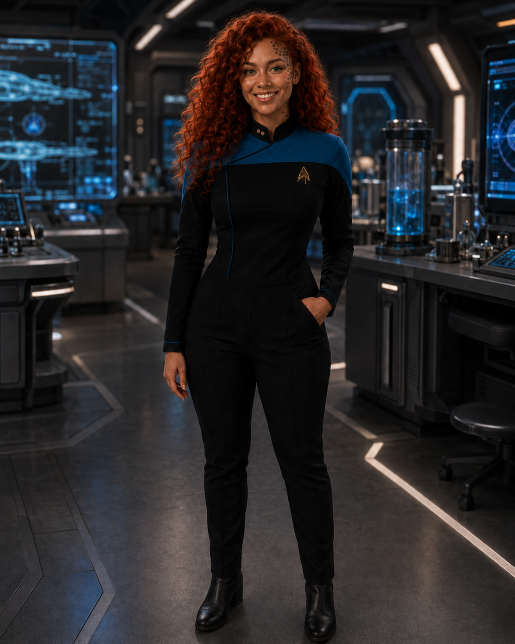
Lieutenant Arel Vey
Name Arel Vey
Position Chief Science Officer
Rank Lieutenant
Character Information
| Gender | Female | |
| Species | Trill (Joined) | |
| Age | 27 |
Physical Appearance
| Height | 5' 6" | |
| Weight | 148 lbs | |
| Hair Color | Rich Copper Red | |
| Eye Color | Deep Green | |
| Physical Description | Arel stands 5’6” and weighs 148 lbs. Her warm brown skin is marked by fine Trill spots sweeping from her temples down both sides of her body. Thick copper-red curls frame her face and fall beyond her shoulders in an unruly, Merida-like mass that rarely stays fully restrained for long. Deep green eyes give her an alert, thoughtful expression, while a faint scar across the base of one palm remains the only obvious mark from her life before joining. |
Family
| Father | Tovan Taren (56) - Atmospheric systems engineer | |
| Mother | Lessa Taren (54) - Mathematics and computational sciences lecturer | |
| Brother(s) | Kalen Taren (31) - Atmospheric survey pilot Rian Taren (23) - Planetary infrastructure technician |
|
| Sister(s) | Sela Taren (34) - Planetary ecologist | |
| Other Family | Maternal Grandmother: Nira Velan (81) - Retired planetary climatologist Paternal Uncle: Rel Taren (60) - Civilian long-range survey captain Romantic Partner, erased from history: Jalen Rho (27 at the time of disappearance) - Starfleet operations officer and sensor systems specialist |
Personality & Traits
| General Overview | Arel is curious, quietly warm and difficult to discourage once a question has caught hold of her. She enjoys being challenged and respects people who admit uncertainty, but has little patience for intellectual posturing or careless conclusions. Joining has given her greater patience and perspective, though neither has entirely tamed her ambition. Beneath her composed, thoughtful manner sits a stubborn need to understand what others would rather leave unexplained. She is attentive to the people around her and often remembers details they have forgotten sharing, yet remains guarded about her own grief. When frightened or emotionally exposed, Arel becomes more precise and professional, retreating into evidence, procedure and work until she feels steady enough to face what cannot be measured. | |
| Strengths & Weaknesses | Arel is an imaginative and highly capable scientist, able to hold several competing explanations in mind without forcing the evidence to fit whichever one she prefers. She is particularly skilled at recognising patterns within contradictory sensor data and explaining complicated ideas without burying others beneath technical language. Curious, attentive and quietly warm, she remembers small details about the people around her and gives junior officers room to question her conclusions. When circumstances become strange or dangerous, she remains functional and methodical, often becoming calmer and more precise as the situation worsens. That same composure can make Arel difficult to read, particularly when she retreats into analysis rather than admit that something has frightened or hurt her. She struggles to delegate work connected to anomalies resembling the incident that erased Rho, hovering too closely over trusted colleagues while insisting she is only being thorough. Her ambition has survived its consequences, leaving her vulnerable to pursuing an answer beyond the point where caution should have stopped her. She dislikes abandoning unresolved questions and can become controlling when she fears another person may be lost, even as the uncertainty within her own memories leaves her privately questioning whether instinct, grief or evidence is guiding her. |
|
| Ambitions | Arel wants to become the kind of scientist trusted with questions others are afraid to ask. More privately, she hopes to prove that Rho truly existed and discover whether he can be found, restored or at least remembered by more than herself. She also wants to grow into a leader worthy of the responsibility given to her, though part of her still measures success by whether she can solve the one mystery that cost her everything. | |
| Hobbies & Interests | Arel enjoys collecting old stellar charts and comparing their inaccuracies with modern records, fascinated by what earlier explorers believed they were seeing. She reads terrible mystery holonovels with far more enthusiasm than she admits, keeps handwritten journals and has developed a quiet interest in bookbinding so her notes feel tangible and permanent. Away from work, she prefers strong tea, observatory lounges, long walks and puzzles that reward patience rather than speed. She also retains a fondness for atmospheric patterns from her childhood, and will happily lose an hour watching storms gather over a planetary horizon. |
| Personal History | Arel was born in 2370 in a small inland settlement on Trill, far enough from the major cities that weather systems mattered more to daily life than politics at the Symbiosis Commission. Her father, Tovan, maintained atmospheric regulation and monitoring equipment across the surrounding region, while her mother, Lessa, taught mathematics and computational sciences at a local college. Arel grew up between practical engineering and abstract thought, equally comfortable watching her father strip down a damaged sensor assembly or sitting at the kitchen table while her mother tried to explain why an elegant solution was not necessarily the correct one. She was the third of four children and rarely the quietest. Sela and Kalen were old enough to remember Arel dismantling household equipment simply to see whether she could put it back together. Rian, younger by four years, usually became either her assistant or the unwilling owner of whatever she had borrowed. Arel was bright, impatient and difficult to distract once something caught her attention. She did well at school, though several instructors noted that she was more interested in testing the limits of an assignment than completing it exactly as requested. The possibility of joining appealed to her early. No one else in her immediate family was joined, and her parents took care not to treat selection as a measure of worth. Arel understood that in principle. In practice, she wanted it badly. She wanted the experience of lives beyond her own and the chance to become part of something older than any single career. There was ambition in it too, though she spoke more readily about service, continuity and the Trill ideal when asked by assessors. Arel entered Starfleet Academy in 2388 and followed a science programme built around subspace physics, advanced sensor analysis and causal systems modelling. Academy life suited her better than she had expected. There was always another laboratory open, another lecturer willing to argue and another classmate whose assumptions differed from her own. She was not naturally disciplined, but she learned that good science required more than curiosity and quick thinking. It required patience, documentation and the humility to accept that the most exciting explanation was often wrong. She met Jalen Rho during her second year. Rho was a Bajoran operations cadet specialising in sensor systems, and their first proper conversation became an argument over one of Arel’s models. She believed he was being unnecessarily literal. He believed she had designed an impressive theory for equipment that could not produce the measurements she required. Neither changed their mind that afternoon. They became friends slowly, then something more. Rho was practical where Arel could become consumed by possibility. He remembered meals, sleep and the junior technicians expected to make her ideas work. Arel brought him into questions he might otherwise have dismissed as too speculative. Their relationship survived long hours, competing assignments and the quieter strain created by two ambitious young officers trying to imagine whether their futures would ever place them aboard the same ship. After graduating in 2392, Arel was assigned to the USS Carpathia as a junior science officer. Rho received an operations posting aboard the same vessel, though neither admitted how much that influenced the assignments they had requested. Their first year was unremarkable in the way Arel later came to value: routine surveys, equipment failures, watches that ran long and arguments over whose quarters contained more abandoned PADDs. In 2393, Arel was recalled to Trill after being approved for joining. Vey had lived through five previous hosts, including an archivist, civil engineer, physician, legal scholar and research pilot. The symbiont carried breadth rather than fame, and Arel found that reassuring. There was no celebrated legacy waiting for her to uphold. The joining was successful, but it was not effortless. Arel returned to the Carpathia with memories she had not earned, instincts she could not always explain and preferences that occasionally startled her. Her family adjusted with love and varying amounts of grace. Tovan asked practical questions about her health. Lessa watched more carefully than she spoke. Rian complained that Arel now paused before laughing at his jokes, as though checking whether five other people had found them funny first. Rho struggled too. He never treated Vey as an intruder, but there were moments when Arel’s reactions belonged to experiences he had not shared and could not follow. They argued more during those early months than they had before the joining. What kept them together was not perfect understanding. It was their willingness to admit when understanding had failed. Most colleagues began calling her Vey almost immediately. Rho continued to call her Arel. With Vey’s influence, Arel became more patient and better able to recognise weaknesses in her own reasoning. She also became more ambitious. Five completed lives gave her an uncomfortable awareness of how much could remain unfinished. Her work aboard the Carpathia shifted towards subspace topology and anomalies that produced contradictory sensor records. She began developing a theory that certain phenomena did not merely distort local conditions, but resolved contradictions by altering the chain of events around them. The work earned attention within Starfleet Science. It was imaginative and mathematically sound in places, but difficult to test and too dependent upon incomplete case studies. Arel accepted criticism when it addressed the work. She was less gracious when senior researchers dismissed the entire premise because the implications made them uncomfortable. In 2395, the Carpathia encountered an unstable spatial phenomenon whose behaviour closely resembled several of Arel’s predictions. Passive scans returned conflicting information. Compartments appeared in sensor records where no compartments existed. Internal chronometers fell out of sequence without losing synchronisation. Arel proposed an active sensor pattern intended to map the anomaly’s response to observation. Rho helped adapt the sequence to the ship’s systems. He also argued that they had not modelled the feedback thoroughly enough. Arel believed the anomaly was already changing and that waiting would leave them with nothing but corrupted readings. Rho eventually helped her proceed. She never became certain whether she had convinced him or whether he had simply decided she would be safer with him at the adjoining console. The active scan triggered a brief period of overlapping causal states. Crew members remembered orders that had not been given. Corridors appeared to connect to the wrong sections of the ship. The computer altered records while they were being accessed. When the disturbance ended, Jalen Rho was gone. There was no damaged console, no casualty report and no empty place in the operations roster. His quarters belonged to another officer. Starfleet Academy had no record of him. His parents remembered raising only a daughter. Every photograph and message Arel had shared with him had changed. Arel remembered everything. Vey retained impressions that were less complete: familiar spaces with no clear reason for their familiarity, emotional responses without an identifiable source, and the recurring expectation that someone was about to enter a room. At times the symbiont appeared to support Arel’s memory. At others, Vey’s inherited caution refused to accept certainty where evidence had been compromised. The disagreement remained private, but it left Arel feeling questioned from within her own mind. The inquiry confirmed that the anomaly had been genuine and that the crew had experienced measurable spatial, neurological and chronometric effects. It could not verify Rho’s existence. Arel was not accused of inventing him, nor was she deemed unfit for duty. She was criticised for escalating an experiment before its possible feedback had been properly understood and for allowing personal confidence in her theory to narrow her judgement. Her career did not end, but its direction changed. A promising field placement was withdrawn, and her research was placed under review. In 2395 she accepted a position at Memory Alpha, where she worked on anomalous sensor records and revised the paper that had once seemed likely to establish her reputation. She resented the posting at first, seeing it as a polite way of removing her from active investigation. Over time, the archives gave her something the Carpathia could not: other incidents containing unexplained gaps, altered records and memories that did not agree with documented history. Arel did not find proof of Rho. She found enough similarities to know that the question was larger than her own loss. In 2396, Division 14 approached her about classified anomaly research. They did not promise vindication and did not claim to believe every part of her account. They had, however, identified predictive value in her work and wanted someone capable of recognising causal disturbance before it became impossible to contain. Arel accepted with less hesitation than she later admitted was sensible. Her time with Division 14 restored some professional trust, though not the easier confidence she had possessed before the incident. She became stricter about testing assumptions and more willing to challenge her own conclusions. She also began keeping handwritten records, initially as a precaution and later because she found comfort in the simple resistance of ink on paper. At the end of difficult shifts, she wrote down the names of those who had worked beside her. In 2397, Arel was selected to lead the science department aboard the USS Balam. The appointment placed her aboard a ship designed for the questions that had altered the course of her life. She arrived with an impressive scientific record, a professionally acknowledged failure and a private grief that no official document could name. She still carries Rho’s Bajoran earring, wrapped in dark cloth and kept among her personal effects. She has never submitted it for extensive temporal analysis. The risk of finding nothing has remained harder to face than the possibility of finding an answer. Arel tells herself that she joined Balam because the work matters, because Starfleet needs scientists willing to examine the implausible without abandoning evidence, and because she can help prevent another crew from repeating the mistakes made aboard the Carpathia. All of those things are true. She still counts everyone when the laboratory doors close. |
|
| Service Record | 2388 - 2392 - Science Cadet, Starfleet Academy, Earth 2392 - 2393 - Junior Science Officer, USS Carpathia 2393 - 2395 - Subspace Systems Specialist, USS Carpathia 2395 - 2396 - Research Officer, Starfleet Science Directorate, Memory Alpha 2396 - 2397 - Anomalous Phenomena Analyst, Division 14, classified assignment 2397 - Present - Chief Science Officer, USS Balam |